How to Load a Container: Step-by-Step Loading Plan
Inspect the box, plan before the first carton goes in, keep the center of gravity near mid-length, load from the front wall to the door with heavy goods low, fill the gaps and secure the door end. A practical guide based on the CTU Code.
· 12 min read
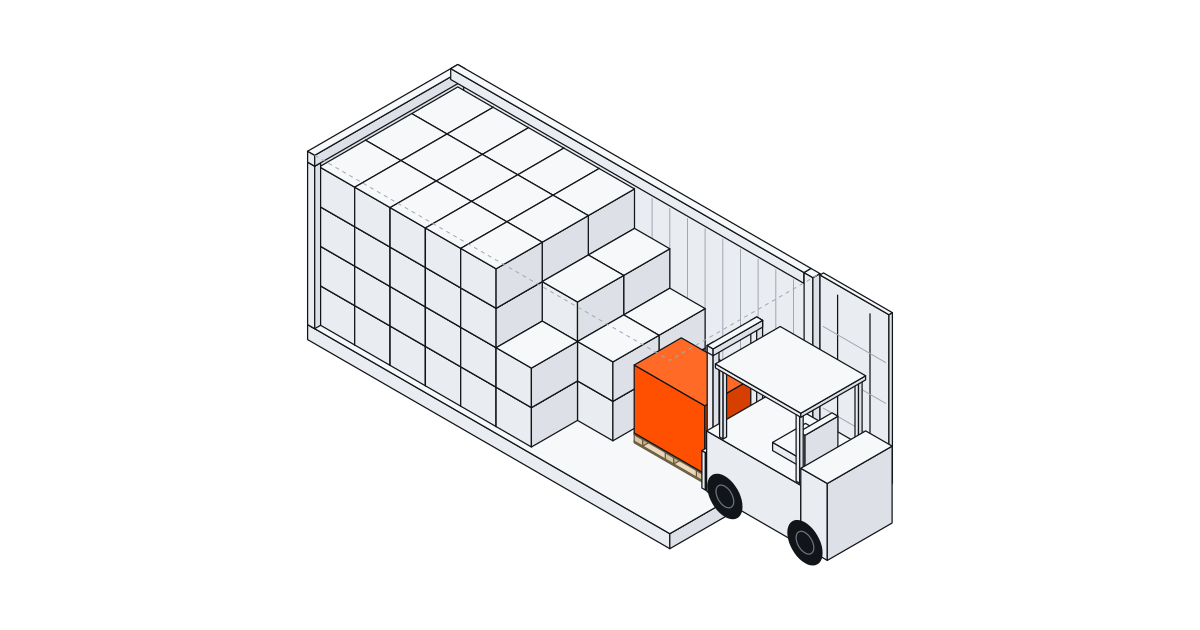
Once the seal is on, you won't see your cargo again until the consignee opens the doors. Whether it survives cranes, ship motion and hard braking on the road is decided before those doors close, so container stuffing is as much a planning job as a warehouse job.
The short answer: load a container from a plan made before loading starts, working from the front wall to the door, with heavy items low and spread across the floor, the center of gravity near mid-length, gaps filled and the door end secured. Then close the doors, seal them and submit the verified gross mass (VGM) to the carrier. The steps below follow the CTU Code (2014), the joint IMO, ILO and UNECE code of practice for packing cargo transport units. It isn't mandatory, but it is the international reference for container loading best practices.
What should you check before loading a container?
Inspect the box first; finding damage after it's full means unloading and starting over. Chapter 8 of the CTU Code lists these checks:
- CSC safety approval plate: usually on the left-hand door. Never exceed the maximum gross mass shown. If the next examination date has passed and there's no ACEP mark, don't use the box internationally.
- Structure and doors: no significant dents, cracks or bends; doors that open, close, lock and take a seal; gaskets in good condition.
- Interior: no broken floorboards or protruding nails. Light coming in with the doors closed means a hole. Liquid, or stains that rub off on a gloved hand, mean you should ask for another container.
- Old labels: placards and marks from previous cargoes should be removed; permanent markings stay.
Before stepping into a closed container, the Code recommends leaving the doors open for a while so the air inside can equalize with outside air. Don't trust the atmosphere in a box that has been shut for a long time.
Which container type should you book?
Choose the container by both volume and weight. The table shows typical internal dimensions and capacities calculated by the StowCargo packing engine. Pallet counts are single layer with no gap between pallets; cartons are 600 × 400 × 400 mm (about 23.6 × 15.7 × 15.7 in) and may be rotated in any direction.
| Container | Internal L × W × H (mm) | Typical max payload | Euro pallets | Industrial pallets | 600 × 400 × 400 cartons |
|---|---|---|---|---|---|
| 20 ft dry | 5,898 × 2,352 × 2,393 | 28,200 kg | 11 | 10 | 282 |
| 40 ft dry | 12,032 × 2,352 × 2,393 | 26,700 kg | 25 | 22 | 590 |
| 40 ft high cube | 12,032 × 2,352 × 2,698 | 26,500 kg | 25 | 22 | 700 |
| 45 ft high cube | 13,556 × 2,352 × 2,698 | 27,700 kg | 27 | 24 | 778 |
| 20 ft open top | 5,894 × 2,347 × 2,348 | 28,100 kg | 11 | 10 | 282 |
| 40 ft open top | 12,029 × 2,342 × 2,347 | 26,500 kg | 25 | 22 | 590 |
| 20 ft reefer | 5,444 × 2,294 × 2,276 | 27,400 kg | 10 | 9 | 262 |
| 40 ft reefer high cube | 11,583 × 2,294 × 2,554 | 29,000 kg | 23 | 20 | 626 |
Internal dimensions vary by a few centimeters between manufacturers; the CSC plate on your box is what counts. Three conclusions follow:
- Dense cargo goes in a 20 ft box. A 40 ft dry container has twice the volume but a lower typical payload, and metal, ceramics or stone hit the weight limit long before the box is full. Road weight limits apply on top; ask your trucker.
- Light, bulky cargo goes in a high cube. On the same floor, the 40 ft high cube adds 305 mm of height and takes 700 cartons instead of 590.
- Heavy pieces a forklift can't drive in with go in from the top or side. The CTU Code notes that modern container floors are designed for a concentrated force of about 0.5 kN/cm², which can limit single packages to roughly 3 to 3.5 tonnes depending on the forklift, and suggests open top or open side units for heavier items.
For more detail, see shipping container dimensions and pallet capacity and the 40 ft high cube container page.
How do you make a container loading plan?
A container loading plan shows where each item goes and in what order; without one, every shift loads by habit. The inputs come from the packing list: quantity, outer dimensions, gross weight, stackability and orientation limits such as "this side up." See how to prepare a packing list for what to collect and, if cartons are palletized first, how many boxes fit on a pallet.
The CTU Code is explicit: when a shipment needs more than one container, plan which packages go into which unit before the first one is packed. Skip this and the last box ends up half full or all the heavy items land in one container.
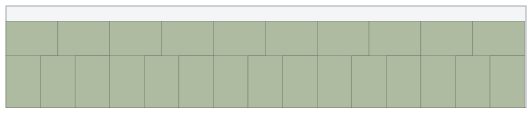
StowCargo builds this plan in seconds: import the list as Excel, CSV, PDF or StowCargo XML, pick the container, and the packing engine places every item in your browser, showing the number of containers, each one's gross weight and the 3D layout.
How should weight be distributed in a container?
The cargo's center of gravity should sit close to the middle of the container's length and width. The CTU Code (annex 7, 3.1.4) says the longitudinal offset should generally not exceed 5% of the length. The rule of thumb: no more than 60% of the cargo's total mass in one half of the container's length. In particular cases up to 10% can be accepted, because advanced spreaders can compensate.
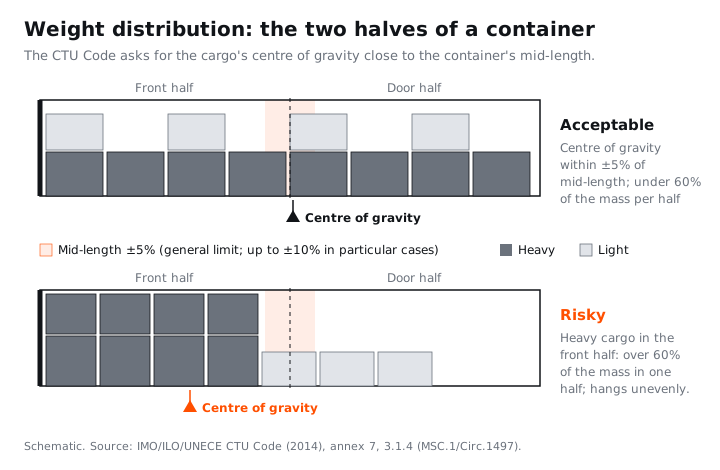
The reason is lifting: a crane picks the box up by its corners and expects it to hang level. The Code asks terminals to rectify the problem when a lift shows the "60% within half the length" rule is exceeded. Three more rules:
- Side to side: keep the center of gravity near half the width; don't line all the heavy items along one wall.
- Vertically: keep it below half the height of the cargo space by loading heavy items low.
- Concentrated loads: bed a heavy item with a small footprint on timber or steel beams so the load reaches the floor's cross members.
StowCargo shows how the load splits between the two halves of a container in the Balance tab and warns when more than 60% sits in one half. By default the load starts flush against the front wall and the right-hand wall, the way loaders work. You can change this under Summary → Load position to Front, Center, Door or Balanced. With Balanced, the 60% rule becomes part of the placement; in the other positions it stays a warning.
In what order should a container be loaded?
Load from the front wall (the closed end) toward the door in vertical rows. Build each row from the floor up: heavy, sturdy items at the bottom, light and fragile items on top. One of the CTU Code's basic rules is never to stow heavy goods on top of light goods.
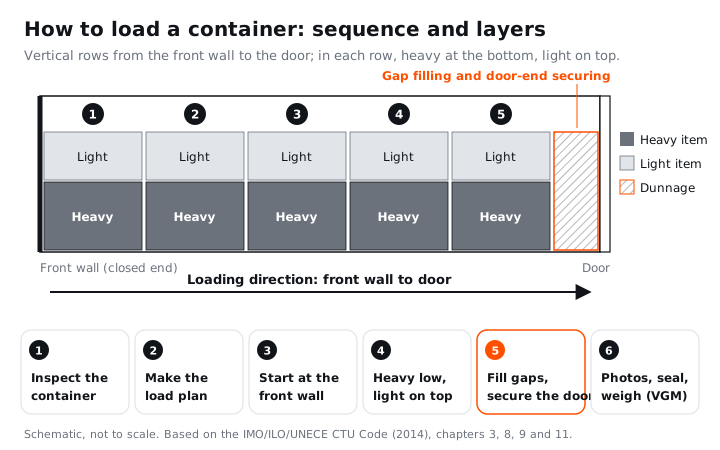
When setting the sequence:
- Build even layers. Keep same-size cartons together so the next layer sits flat.
- Follow package markings. "This side up," stacking limits and fragile labels constrain the plan.
- Put what comes out first at the door, such as items for a second consignee or likely customs inspection.
- Stow dangerous goods near the door where possible. The Code recommends this explicitly; incompatible goods are segregated as well.
- Don't close the doors before the last row and the door end are secured.
StowCargo's default priority is space first: to fill gaps best, non-stackable flags, layer limits and the heavy-on-light rule are ignored, while orientation limits and base support are kept. If a heavy carton must never sit on a lighter one, switch off "Heavy on light" in the Rules menu or set the priority to Stacking rules.
How do you fill gaps and secure the load?
A gap is distance the cargo can travel. The CTU Code asks for blocking, lashing or both to stop sliding and tipping in any direction, and gives a clear figure for voids: small gaps needed for loading and unloading are acceptable, but the sum of void spaces in any horizontal direction should not exceed 15 cm. With dense, rigid cargo such as steel, concrete or stone, gaps should be smaller still. Small gaps between pallets don't need filling if the goods are firmly secured to the pallets by lashing or shrink wrap, the pallets are stowed tightly and they can't tip.
Common gap fillers:
- Empty pallets: stood on edge and tightened with timber battens.
- Dunnage bags: follow the manufacturer's filling pressure and maximum gap. The Code suggests a safety factor of 0.75 for single-use bags and 0.5 for reusable ones when estimating blocking capacity.
- Timber and wedges: avoid materials that deform or shrink permanently, such as rags or weak foam.
Pay special attention to the door end. Per the CTU Code, a general purpose container's side walls are designed for a uniform load equal to 60% of the payload, the front wall and door end for 40%. The doors aren't a securing device: block or lash the last row so it stands on its own, which also protects whoever opens the doors at destination.
For lashing forces and EN 12195-1, read our guide to load securing under EN 12195-1.
What happens after the container is loaded?
Close the doors, make sure every locking bar is engaged, and for international transport seal the container right away with a uniquely numbered seal. The CTU Code notes that countries may require seals meeting ISO 17712.
Then the paperwork starts. Under the Code, the packer tells the shipper the container number, the verified gross mass and the seal number, so they appear on the bill of lading, the cargo manifest and other transport documents.
The Code doesn't require photos, but take them anyway: the empty interior, loading stages, the door-end securing and the seal number. In a damage claim they may be your only evidence.
In StowCargo the plan reaches the warehouse as a phone link. The warehouse loading screen shows each item in sequence, reports progress live and attaches a vehicle photo; it needs no account and opens in English, Turkish, German or Russian. The same plan produces an A4 loading report, sequence labels and a packing list with net and gross weight per container.
Can a container be loaded on a ship without a VGM?
No. Under SOLAS chapter VI, regulation 2, a packed container has needed a verified gross mass before vessel loading since July 1, 2016 (IMO, 2016). There are two ways to get it: weigh the packed container, or weigh everything that goes in and add the container's tare. Our guide to VGM and the SOLAS requirement explains Method 1, Method 2 and who is responsible.
What are the most common container loading mistakes?
- Skipping the inspection: a hole, a wet floor or an expired CSC plate shows up after the work is done.
- Watching volume, forgetting weight: a 40 ft dry container's typical payload is lower than a 20 ft's.
- Piling all the weight in the first rows: it shifts the center of gravity forward and breaks the 60% rule.
- Treating the doors as a securing device: the door end is designed for only 40% of the payload.
- Planning on the dock: decisions made while loading can't be undone.
Conclusion
A well-loaded container comes from preparation, not speed on the dock: a sound box, the right type, a plan built from the packing list, the center of gravity kept near the middle, rows built heavy low and light on top, gaps filled and a secured door end. The seal and the VGM complete the job once the doors close.
To see how many cartons or pallets of one size fit in your container, try the free load calculator; no account needed. For mixed packing lists, balance warnings and a loading link for the warehouse, see the plans on our pricing page.