Load Securing Rules: EN 12195-1 and How Many Straps
On the road, cargo is pushed forward with 0.8 times its weight and sideways or backward with 0.5. EN 12195-1 sets out how to secure against that. Methods, strap labels, friction and a step-by-step strap count.
· 12 min read
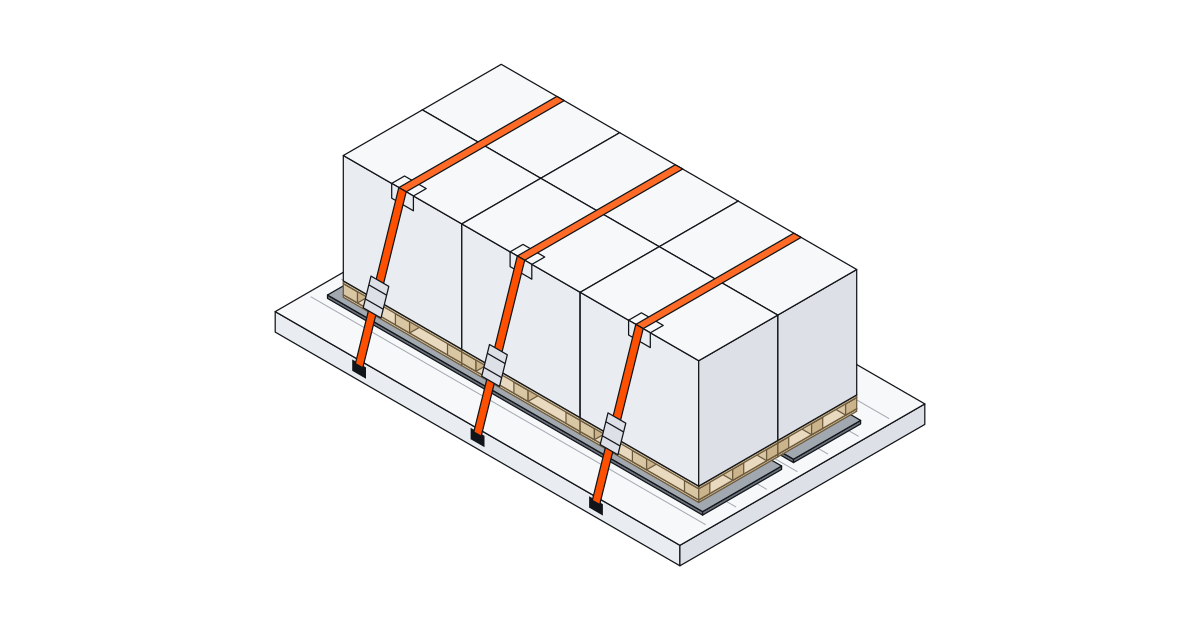
In a hard stop, the cargo in a trailer is pushed forward with a force close to its own weight. Freight that isn't tied down, or that has gaps around it, slides, hits the headboard, tears the curtain or tips over. Load securing means taking up those forces with blocking, friction and lashings.
The short answer: in Europe, road cargo securing is based on EN 12195-1. The securing arrangement has to withstand 0.8 times the cargo weight forward and 0.5 times sideways and backward. The same figures appear in the EU roadside inspection directive. Below you'll find the securing methods, what the LC and STF values on a strap label mean, how much friction matters, and a worked strap calculation.
Why does load securing matter?
Load securing is a safety issue and a legal duty. Shifting cargo upsets braking and stability, can break through the headboard or fall onto the road, usually in a single emergency stop or a tight bend.
In the EU, Directive 2014/47/EU (2014) on roadside technical inspection of commercial vehicles sets out cargo securing principles and deficiency classes in Annex III. Deficiencies are graded minor, major or dangerous. For example, when cargo is blocked against the front wall and the gap is more than 15 cm with a danger of penetrating the wall, it falls into the most serious class. Because the directive covers commercial vehicles circulating in EU member states, trucks from outside the EU, including Turkish exports, can face the same checks.
What forces does EN 12195-1 require for road transport?
EN 12195-1 is the European standard for calculating securing forces. For road transport, the forces the cargo must be held against are given as fractions of its weight:
- Forward (braking): 0.8 × weight
- Backward: 0.5 × weight
- Sideways: 0.5 × weight; 0.6 × weight when checking a load that can tip over
- Vertical: a coefficient of 1.0, meaning the force pressing the load onto the floor is its own weight
These figures are identical in Annex III of Directive 2014/47/EU and in the European Commission's Cargo securing for road transport: 2014 European best practices guidelines. The guidelines are based on EN 12195-1:2010, the version in force when they were written.
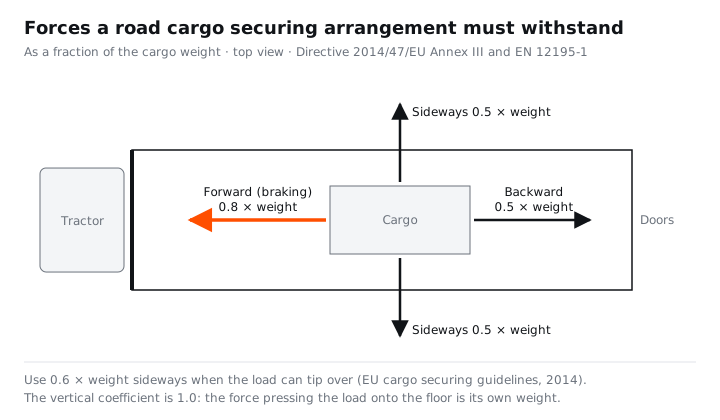
Put simply, a 10 t load in an emergency stop is pushed forward with a force equal to about 8 t of weight, shared between friction, lashings and the headboard.
What are the load securing methods?
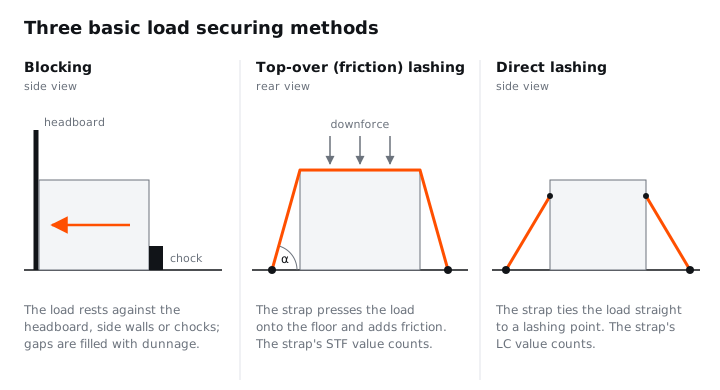
There are four methods: locking, blocking, direct lashing and top-over lashing. Locking uses purpose-built fittings such as container twistlocks; general freight mostly relies on a combination of the other three.
Blocking
Blocking means stowing the cargo tightly against the headboard, the side walls, or chocks, stanchions and bars fixed to the vehicle. The force goes straight into the vehicle body before the load can move. The condition is that there's no gap. Remaining gaps are filled with empty pallets on end, timber or air cushions; the guidelines warn against using air cushions against doors or non-rigid partitions.
Top-over (friction) lashing
In top-over lashing the strap runs over the load and presses it onto the floor; the extra downforce increases friction. It works best on a high-friction floor, and the calculation uses the strap's tension (STF). The guidelines note that on deformable cargo the tension can drop to half or less during the journey, so straps should be re-tightened on the road.
Direct lashing
In direct lashing a strap or chain ties the load to a lashing point; when the load starts to move, the strap takes the force. The calculation uses the strap's lashing capacity (LC). It suits heavy machinery, coils and crates, and the capacity of the lashing points counts too.
What do LC and STF mean on a strap label?
Every ratchet strap carries a label under EN 12195-2, and the calculation uses its values, which, as the EU guidelines stress, can't be judged by eye.
- LC (lashing capacity): the maximum force the strap may carry in a straight pull, in daN. Used for direct lashing. If the label shows two LC values, use the lower one, which is the one defined in the standard.
- STF (standard tension force): the tension left in the strap after the ratchet handle is pulled with a 50 daN hand force (SHF). This is the value used for top-over lashing; LC doesn't decide the result there.
According to the guidelines, the most common strap in professional haulage is a 50 mm polyester strap with an STF of 250–500 daN and an LC of 1,600–2,000 daN. The actual tension after ratcheting can be anywhere from 0 to 600 daN. Don't count a strap whose label is missing or worn.
How much does friction change the result?
The friction factor (μ) describes how well the load grips the floor, and it changes the strap count more than any other input. The EU guidelines reproduce typical values from Annex B of EN 12195-1:2010:
| Contact surfaces | μ |
|---|---|
| Sawn wood on plywood floor | 0.45 |
| Planed wood on plywood floor | 0.30 |
| Plastic pallet on plywood floor | 0.20 |
| Rubber anti-slip mat | 0.60 |
| Floor not swept clean, or with frost, ice or snow (maximum) | 0.20 |
The values apply to clean surfaces, dry or wet. A rubber mat counts as 0.6; anything higher needs a test certificate. On a floor that hasn't been swept or has ice or snow on it, no value above 0.2 may be used. In practice the cheapest improvement is to sweep the floor and put mats under the pallets.
How do you calculate how many lashing straps you need?
For top-over lashing, the minimum number of straps comes from this EN 12195-1 equation:
n ≥ (c − μ × c_z) × m × g × f_s ÷ (2 × μ × sin α × F_T)
- n: number of straps; m: cargo mass (kg); g: 9.81 m/s²
- c: horizontal coefficient (0.8 forward; 0.5 sideways and backward); c_z: vertical coefficient, 1.0
- μ: friction factor; α: vertical angle between strap and floor
- f_s: safety factor, 1.25 forward and 1.1 sideways and backward in the EU guidelines' examples
- F_T: strap tension (N), taken from the STF on the label
The top line is the force friction can't cover; the bottom line is the grip one strap adds. If μ is equal to or larger than c, the top line is zero or negative and friction alone stops sliding in that direction.
Worked example: a 20 t palletised load
This example only illustrates how the equation behaves. Assumptions: 20,000 kg of cargo, planed-wood pallets on a plywood floor (μ 0.3), STF 400 daN (4,000 N), strap angle 75° (sin α ≈ 0.966). One strap's bottom-line value: 2 × 0.3 × 0.966 × 4,000 ≈ 2,318.
- Sideways and backward, μ 0.3: (0.5 − 0.3) × 20,000 × 9.81 × 1.1 = 43,164; 43,164 ÷ 2,318 ≈ 18.6 → 19 straps.
- Forward, load not against the headboard, μ 0.3: (0.8 − 0.3) × 20,000 × 9.81 × 1.25 = 122,625; 122,625 ÷ 2,318 ≈ 52.9 → 53 straps.
- Forward, with anti-slip mats, μ 0.6: bottom line 2 × 0.6 × 0.966 × 4,000 ≈ 4,636; (0.8 − 0.6) × 20,000 × 9.81 × 1.25 = 49,050; 49,050 ÷ 4,636 ≈ 10.6 → 11 straps.
- Sideways and backward, with mats, μ 0.6: 0.5 − 0.6 is negative, so no straps are needed against sliding.
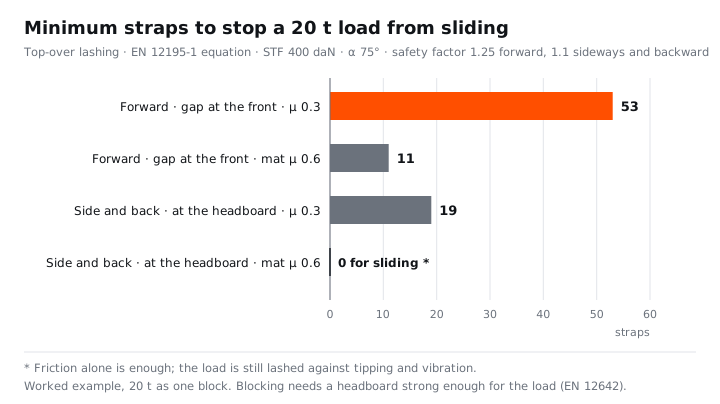
Two things stand out. Without the headboard, the forward direction decides everything, and 53 straps on a 13.6 m trailer isn't realistic. And anti-slip mats cut the forward count to about a fifth. This covers sliding only; tipping, lashing point capacity and each cargo unit still need checking, which the Quick Lashing Guide in the guidelines' appendix simplifies.
How does loading against the headboard reduce the number of straps?
When the load sits flush against the headboard, the headboard takes the forward force and sideways and backward become the deciding directions. In the example above that's the difference between 53 and 19 straps. The condition is that the headboard is strong enough. The EU guidelines describe two EN 12642 strength classes:
- EN 12642 XL headboard: withstands 50% of the payload. With a friction factor of at least 0.3 it can take the forward force of a full payload on its own.
- EN 12642 L headboard: withstands 40% of the payload, capped at 5,000 daN for vehicles with more than 12.5 t payload. According to the guidelines' table, that means only 10.1 t can be blocked against it at μ 0.3, and 25.4 t at μ 0.6.
Side walls follow the same logic: the curtains of an EN 12642 L curtainsider are weather protection only. Check the vehicle's certificate; an unmarked headboard counts as zero strength.
StowCargo's packing engine starts the load flush against the cab-side front wall and one side wall, the way loaders do, which makes blocking easier from the start. If the load is very heavy and the tractor would be overloaded, the engine moves it back toward the doors only as far as needed, and the front gap then has to be filled. How weight splits between kingpin and axles is worked through in our axle load calculation guide.
What does StowCargo's securing suggestion calculate?
StowCargo adds a securing suggestion to every plan. It's an estimate, and responsibility stays with the loader. It tells you two things:
- Gaps: gaps of 10 cm or more between the load and the front wall, at the door end and along the sides, with their position and width, so you know where dunnage, chocks or air cushions are needed.
- Estimated strap count: for road vehicles, calculated with the EN 12195-1 top-over lashing relationship. The assumptions are shown on screen: μ 0.3 (0.6 if you tick anti-slip mats), strap tension 400 daN, angle 75°, safety factor 1.1 sideways and backward, 1.25 forward. The load is split into sections of about 1.2 m and every occupied section gets at least one strap. If the load isn't against the front wall, the forward direction (0.8) is included. No strap count is calculated for containers.
Wall classes, lashing point ratings, strap labels and the state of the floor can only be checked at the dock, so treat the suggestion as a starting checklist; the final call belongs to the competent person at the vehicle. Containers also fall under the IMO/ILO/UNECE CTU Code; see how to load a container.
A short pre-departure checklist
The EU guidelines split responsibility between shipper, loader, carrier and driver. The shipper starts by describing the cargo: each unit's weight, its centre of gravity if off-centre, outer dimensions and stacking or orientation limits, all of which come from the packing list. Before loading:
- Sweep the floor; with ice, snow or oil, don't assume μ above 0.2.
- Load flush against the headboard and one side wall, and fill any remaining gaps.
- Check the vehicle's headboard and side wall class (EN 12642 L or XL) on its certificate.
- Read the strap labels; don't use unlabelled or cut straps, and protect them at sharp edges.
- Space straps evenly and re-tighten them on the road, especially over deformable cargo.
- Confirm the gross weight and axle loads stay within limits.
To follow the loading sequence step by step on a phone at the dock, see warehouse loading; for inside dimensions, see the 13.60 m curtainsider trailer page.
Conclusion
The basis of load securing is simple: hold the cargo against 0.8 × its weight forward and 0.5 × sideways and backward. The cheapest way to get there is usually the same, too: load flush against the headboard and a side wall, keep the floor clean and add friction with mats. The strap calculation sits on top of that, using the values printed on the label.
To see how your load fits a vehicle and where the gaps are, start with the free load calculator. To plan a full packing list and add the securing suggestion and axle estimate to your loading report, open a plan in the workspace.