VGM Explained: SOLAS Verified Gross Mass, Method 1 and 2
VGM is the total mass of a packed container, verified by an approved method, and since July 1, 2016 SOLAS makes it a condition for loading on a ship. Method 1 vs Method 2, who is responsible, how Turkey applies it, and where a load plan helps.
· 10 min read
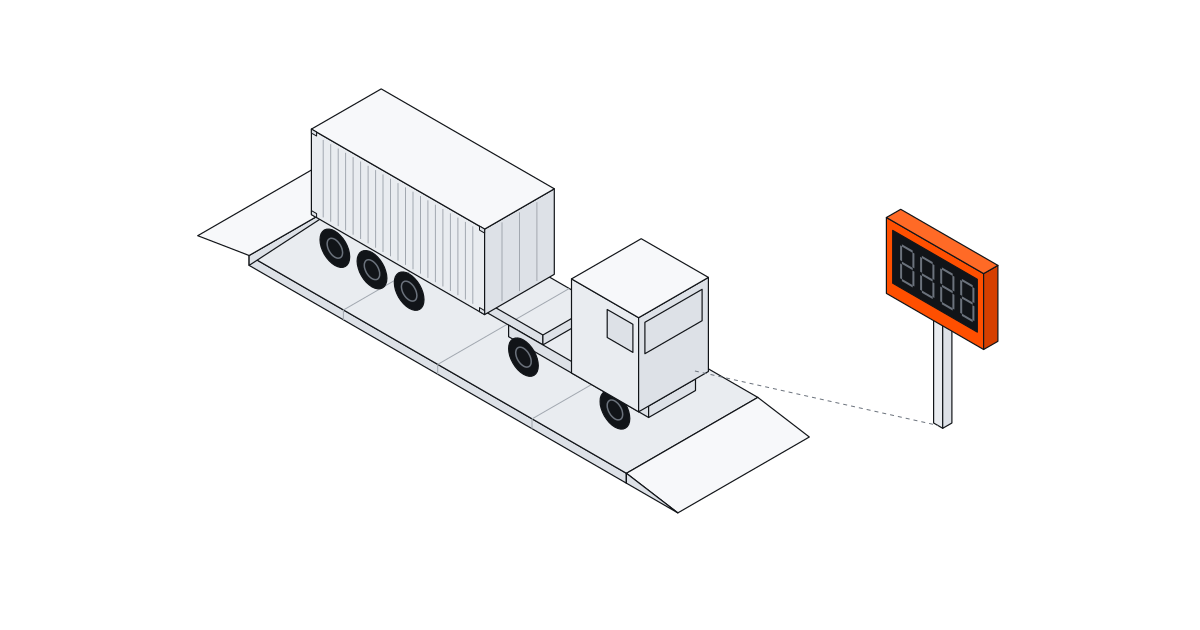
Every exporter who ships by sea eventually gets the same email from a forwarder: "VGM still missing." If it stays missing, the container sits at the terminal and can miss its vessel. The rule itself is simple, but the details, from what counts toward the weight to who may use Method 2, trip people up.
The short answer: VGM (verified gross mass) is the total mass of a packed container, obtained by weighing or by a certified calculation: cargo, packaging, pallets, dunnage and securing material, plus the container's tare. Under SOLAS chapter VI, regulation 2, a packed container without a VGM has not been loaded on a ship since July 1, 2016. The shipper is responsible for it.
What is VGM?
VGM is the gross mass of a packed container, verified by one of the two methods SOLAS prescribes. IMO's implementation guidelines, MSC.1/Circ.1475 (2014), define gross mass as the container's tare mass plus the masses of all packages and cargo items, including pallets, dunnage and other packing and securing material.
Two distinctions matter:
- A declared weight is not a VGM. The estimate on a booking, invoice or bill of lading isn't verified. If the two differ, IMO's guidelines say the verified gross mass prevails.
- The truck isn't part of it. If the container is weighed on a chassis or trailer, the vehicle's tare is subtracted; tractor and chassis don't count.
When did the SOLAS VGM requirement take effect?
IMO's Maritime Safety Committee adopted the amendment to SOLAS regulation VI/2 at its 94th session, November 17–21, 2014, by resolution MSC.380(94). It was deemed accepted on January 1, 2016 and entered into force on July 1, 2016 (IMO).
The point is ship safety. The master and the terminal build the stowage plan from container weights, and a misdeclared weight affects vessel stability, the load on containers lower in the stack, and lifting equipment. So the rule is a loading condition: no VGM, no loading. IMO also notes that a VGM doesn't guarantee loading; the master keeps the final say.
Who is responsible for VGM?
The shipper is responsible. IMO defines the shipper as the party named as shipper on the bill of lading, sea waybill or equivalent multimodal document, or the party that concluded the contract of carriage with the shipping line.
The shipper can have someone else weigh the container. If a logistics provider packs the box, IMO's guidelines ask that party to tell the shipper the masses of the cargo and the packing and securing material it loaded. Contracting the work out doesn't move the responsibility, though: the shipper still has to obtain the VGM and get it to the carrier and terminal in time for the stowage plan.
Method 1 vs Method 2: what's the difference?
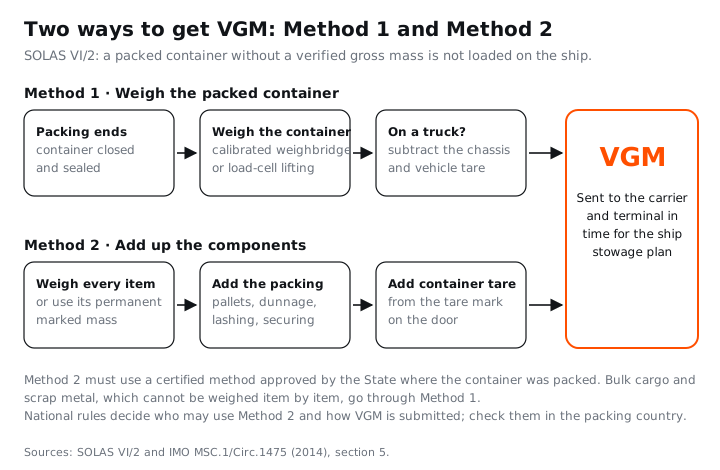
Method 1 weighs the packed container as a whole. Method 2 weighs everything that goes into the container, adds it up and adds the container's tare. Both are valid, but Method 2 needs a certified method approved by the country where the container was packed.
Method 1: weigh the packed container
Once packing is complete and the container is closed and sealed, the packed container is weighed, typically on a weighbridge or with load-cell lifting equipment. The equipment must meet the accuracy standards of the country where the weighing takes place. If the container is weighed on a truck, the vehicle tare is subtracted; Turkey's rules, for example, allow either weighing the vehicle loaded and empty or subtracting a documented vehicle tare, and require fuel in the tank to be taken into account. Two containers on one trailer must be weighed separately.
Method 2: add up the components
The shipper weighs every package and cargo item, including pallets, dunnage and other packing and securing material, and adds the container's tare using a certified method. Original sealed packages with an accurate mass permanently marked on them don't need to be weighed again. Cargo that can't be weighed item by item, such as scrap metal or unbagged grain, isn't suitable for Method 2 and goes through Method 1.
How Method 2 is certified is up to each country. It can cover the weighing procedure, the party doing it or both. Check the rules in the country where the box is packed before you rely on it.
| Method 1 | Method 2 | |
|---|---|---|
| What is weighed | The packed, sealed container | Every item, pallet, packing and securing material |
| Container tare | Already included in the reading | Added from the tare mark on the container |
| Approval | Calibrated, certified equipment | A certified method approved by the packing country |
| Not suitable for | No restriction | Bulk cargo, scrap metal |
What goes into the VGM?
The VGM includes everything inside the container and the container itself:
- Cargo: the goods, with their inner packaging.
- Packaging and pallets: cartons, crates, pallets, stretch wrap, corner boards.
- Dunnage and securing material: timber, wedges, dunnage bags, straps, anti-slip mats.
- Container tare: the empty container's mass, marked on the box under the ISO 6346 marking standard, usually on the doors.
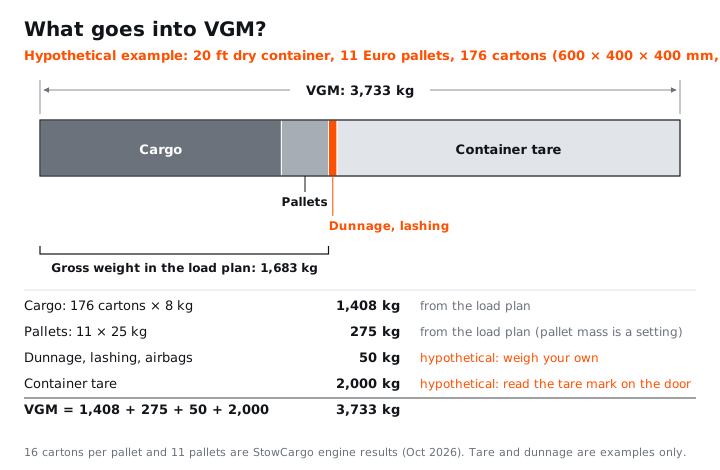
Here's the VGM calculation behind the chart. A 20 ft dry container takes 11 Euro pallets in a single layer, and each pallet holds 16 cartons of 600 × 400 × 400 mm at 8 kg (StowCargo packing engine results). The 176 cartons weigh 1,408 kg. At 25 kg per pallet, the pallets add 275 kg, so the load plan shows a gross weight of 1,683 kg (about 3,710 lb). The 50 kg of dunnage and the 2,000 kg tare are hypothetical values. Total: 3,733 kg. With light cargo, forgetting the tare is the biggest possible error: in this example the tare is more than half the VGM.
How does Turkey implement VGM?
If you ship from Turkey, VGM is called DBA (doğrulanmış brüt ağırlık) and is governed by a directive of the Ministry of Transport and Infrastructure (UAB directive, in Turkish) in force since May 1, 2019. Its main points, which you should check against the current text:
- The VGM document comes only from the ministry's DBA information system, issued by weighing operators the ministry has authorized. Terminals accept only the QR-coded document from that system.
- Plus or minus 5%: the difference between the declared VGM and the actual gross mass may not exceed ±5%. The directive sets this as the threshold for administrative sanctions and states it doesn't relieve the shipper of determining the VGM as accurately as possible.
- Terminal weighing: if the terminal's weighing differs from the declared VGM by more than ±5%, the terminal issues the final VGM document and notifies the harbor master.
- Method 2 is restricted to shippers holding authorized economic operator or approved person status who are also authorized by the ministry as weighing operators. Unprocessed marble blocks join bulk cargo and scrap on the Method 1 list.
- Consolidated containers with cargo from several parties are weighed by Method 1, by the contractual shipper or the forwarder acting as shipper.
Is there an international tolerance?
No. SOLAS doesn't set one. IMO's guidelines leave weighing accuracy to the country where the weighing takes place and say that when VGMs differ, the one obtained by the terminal's weighing prevails. Turkey's ±5% is a national rule; other countries apply their own.
How does a load plan help you prepare the VGM?
A load plan doesn't replace the VGM, but it moves the surprises from the terminal gate to your desk.
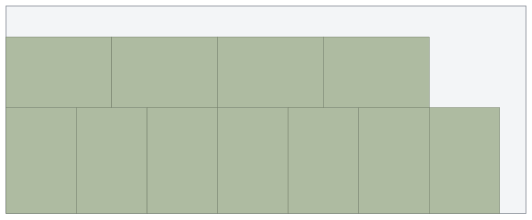
StowCargo totals the gross cargo weight of each container from the item weights on the packing list. When cartons are palletized, the pallet weight (a setting) is added to the gross; when net weight is entered per item, net weight is shown too. The packing list per container comes in English and Turkish with net and gross kilograms, and the same data exports to Excel, CSV and StowCargo XML.
That total does three jobs:
- Payload check: if a container would exceed its maximum payload, you see it in the plan, not at the scale. The maximum on the CSC plate must never be exceeded.
- A target for the scale: add dunnage, securing material and tare to the plan's gross weight and you know what the weighbridge should show. A large gap points to a missing or extra item.
- Weight distribution: the same plan shows how the load splits between the container's two halves. See our guide on how to load a container.
To be clear: StowCargo doesn't issue VGM documents or VGM declarations. The plan's weight is only as accurate as the weights on the packing list; our guide on how to prepare a packing list covers how to collect them.
What are the most common VGM mistakes?
- Forgetting the container tare: the cargo's gross weight is not the VGM. Read the tare from the marking on the box.
- Leaving out dunnage and securing material: timber, airbags and straps count.
- Submitting an estimate as the VGM: an invoice or proforma weight isn't verified, and in countries with a tolerance rule, such as Turkey's ±5%, a large gap can lead to sanctions.
- Using Method 2 without approval: it requires a certified method approved in the packing country.
- Weighing on a truck without subtracting the vehicle tare correctly.
- Missing the VGM cut-off: carriers publish VGM cut-off times for each sailing; a late VGM means the box can miss the ship.
Conclusion
VGM is the real, all-in weight of a packed container and a condition for loading it on a ship. The shipper is responsible. Method 1 weighs the packed container; Method 2 adds up the components with a certified method. National rules decide the details, from Turkey's ±5% limit to who may use Method 2. A good load plan tells you the weights before the container reaches the scale.
For container sizes and payloads, see the 20 ft dry container page and our guide to shipping container dimensions. For a quick single-product check, use the free load calculator; for a packing list with gross weight per container and a full loading plan, see the pricing page.