How Many Boxes Fit on a Pallet? Step-by-Step Calculation
Boxes per pallet = boxes per layer × layers, capped by weight. A 600 × 400 × 400 mm carton gives 16 per Euro pallet. Five worked examples, turning cartons on their side, pallet patterns, and how 3,000 cartons become pallets and trucks.
· 11 min read
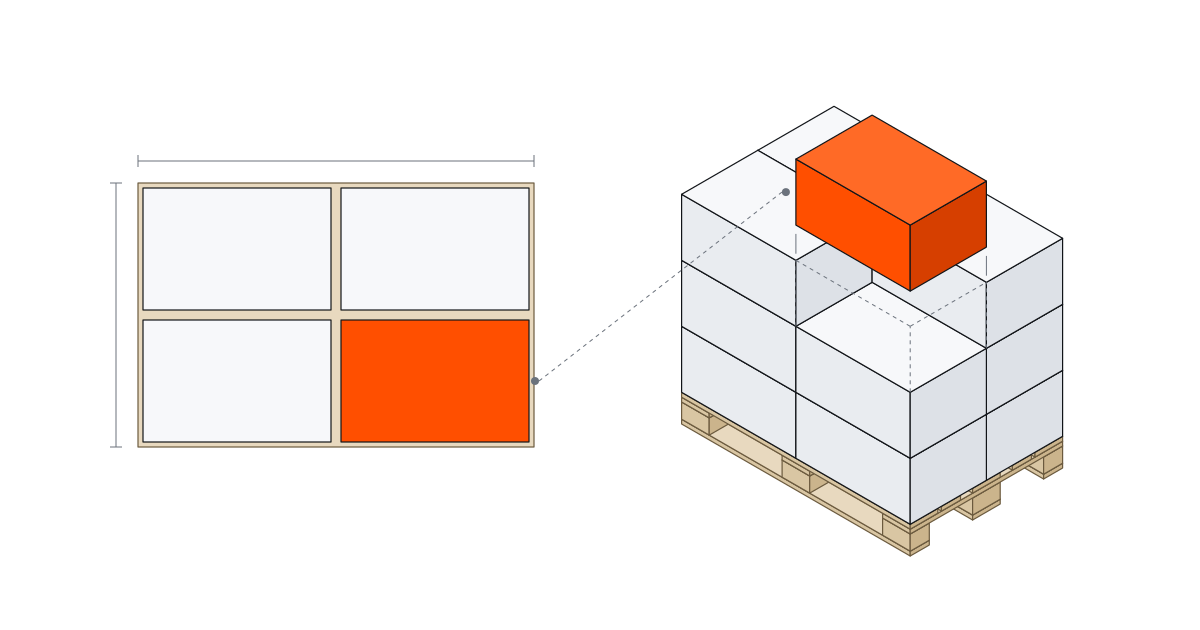
Every shipper that moves goods in cartons runs into the same question: how many boxes fit on a pallet? The answer sets your pallet count, the pallet count sets the number of trucks, and the trucks set your freight bill. Yet the math is often done in a spreadsheet, by trial and error, with the carton in one orientation only, and it leaves a few boxes per pallet on the table.
The short answer: boxes per pallet = boxes per layer × number of layers, as long as the total stays under the pallet's weight limit. A 600 × 400 × 400 mm carton fits 4 per layer on a Euro pallet, four layers high, for 16 in total. Below you'll find the calculation in six steps, five worked examples computed by the StowCargo packing engine, and how pallets translate into trucks.
What do you need for a pallet calculation?
You need seven inputs. Each missing one makes the result either too optimistic or needlessly cautious.
- Carton outer dimensions (length × width × height in mm). Outer, not inner.
- Carton gross weight (kg, contents and packaging).
- Pallet footprint: Euro pallet 1,200 × 800 mm, industrial pallet 1,200 × 1,000 mm. Details in Euro pallet dimensions.
- Pallet height and weight: a Euro pallet is 144 mm high; the calculations here use 25 kg for an empty pallet.
- Maximum height including the pallet: set by racking, the vehicle door or the customer. The examples use 1,800 mm (about 71 inches).
- Maximum load per pallet: 1,000 kg excluding the pallet in the examples. EPAL rates the Euro pallet at a 1,500 kg safe working load (2026); your own limit may be lower, depending on carton strength.
- Orientation: can the carton be turned any way, or is it “this side up”?
Most of this is already on the packing list. If carton dimensions and gross weights are missing, see how to prepare a packing list for the columns to include.
How do you calculate how many boxes fit on a pallet?
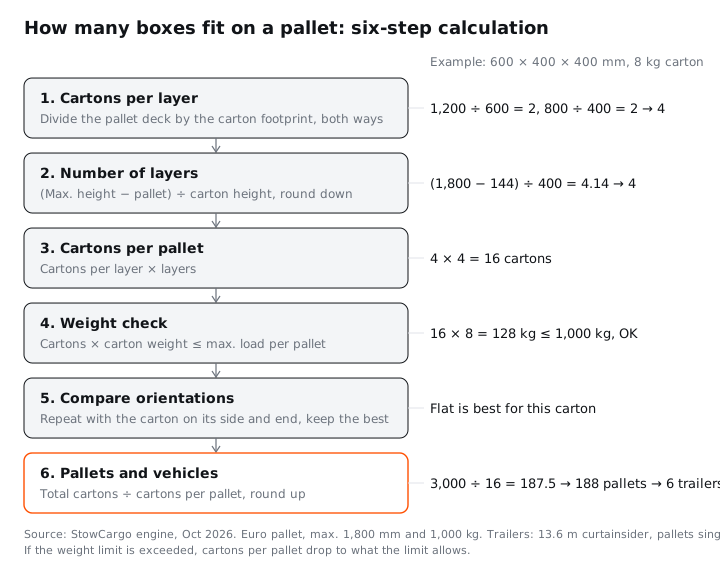
The calculation has six steps. Each one is shown with a 600 × 400 × 400 mm, 8 kg carton on a Euro pallet.
Step 1: Boxes per layer
Divide each side of the pallet deck by the matching carton side and round down. Then rotate the carton 90 degrees and repeat. For a 600 × 400 footprint: 1,200 ÷ 600 = 2 and 800 ÷ 400 = 2, so 4 per layer. Rotated (1,200 ÷ 400 = 3, 800 ÷ 600 = 1), it gives only 3, so the first orientation wins.
Simple division assumes every carton in the layer faces the same way. Mixing rows, some lengthwise and some crosswise, can squeeze more cartons into a layer. Trying that by hand for every carton size is tedious; packing engines test these mixed patterns too.
Step 2: Number of layers
Subtract the pallet height from the maximum height, divide by the carton height and round down: (1,800 − 144) ÷ 400 = 4.14, so 4 layers. The loaded pallet stands 144 + 4 × 400 = 1,744 mm high.
Step 3: Boxes per pallet
Multiply boxes per layer by layers: 4 × 4 = 16 cartons.
Step 4: Check the weight limit
Multiply the count by the carton weight and compare with the maximum load per pallet: 16 × 8 = 128 kg, far below 1,000 kg. With the empty pallet, gross pallet weight is 153 kg. With heavy cartons (tiles, metal parts, liquids), this step changes the answer: boxes per pallet are capped at the maximum load divided by the carton weight.
Step 5: Compare orientations
Unless the carton is “this side up”, repeat the calculation with the carton on its side and on its end, and keep whichever gives the most cartons. For this carton, flat is best. The next section shows two cartons where turning pays off.
Step 6: Pallets and vehicles
Divide total cartons by cartons per pallet and round up: 3,000 ÷ 16 = 187.5, so 188 pallets. A half-full last pallet still takes a full pallet space.
How many boxes fit on a Euro pallet? Five examples
The table below was computed by the StowCargo packing engine in October 2026. Conditions: Euro pallet 1,200 × 800 × 144 mm, empty pallet 25 kg, max. 1,800 mm total height including the pallet, max. 1,000 kg load, cartons free to rotate, no overhang.
| Carton (mm) | Carton weight | Per layer | Layers | Per pallet | Total height | Gross pallet weight |
|---|---|---|---|---|---|---|
| 600 × 400 × 400 | 8 kg | 4 | 4 | 16 | 1,744 mm | 153 kg |
| 400 × 300 × 300 | 4 kg | 8 | 5 | 40 | 1,644 mm | 185 kg |
| 300 × 200 × 200 | 2 kg | 16 | 8 | 128 | 1,744 mm | 281 kg |
| 500 × 300 × 250 (on its side) | 5 kg | 12 | 3 | 36 | 1,644 mm | 205 kg |
| 400 × 400 × 300 (on its side) | 6 kg | 8 | 4 | 32 | 1,744 mm | 217 kg |
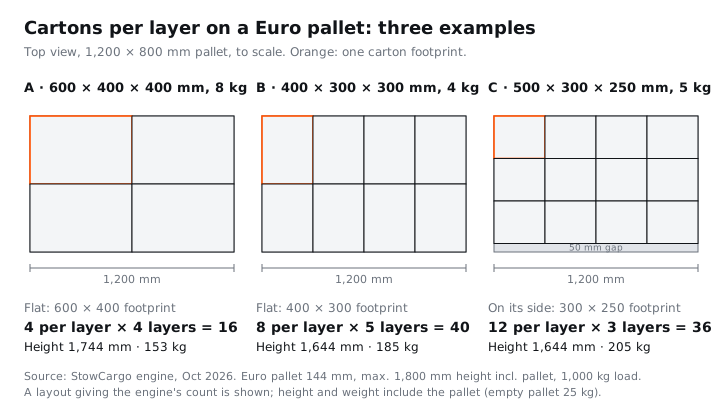
Three lessons stand out. First, cartons whose footprint divides the Euro pallet evenly (600 × 400, 400 × 300, 300 × 200) cover the deck with no gaps. When you design packaging, choosing a footprint that divides the pallet is the cheapest way to raise pallet efficiency. Second, weight was never the limit here; the heaviest pallet is 281 kg. Height and footprint decided. Third, the unused height under 1,800 mm depends on carton height: 156 mm for a 300 mm carton, 56 mm for a 400 mm carton.
When does turning a carton on its side help?
Turning a carton changes either the layer count or the boxes per layer, and sometimes the total goes up. The 400 × 400 × 300 mm carton is a clear case:
- Flat: 400 × 400 footprint, 300 mm high. At most 6 fit per layer on a Euro pallet (1,200 × 800 mm is exactly six 400 × 400 footprints). (1,800 − 144) ÷ 300 = 5 layers, so 30 cartons.
- On its side: 400 × 300 footprint, 400 mm high. 8 per layer, 4 layers: 32 cartons (engine result, 1,744 mm, 217 kg).
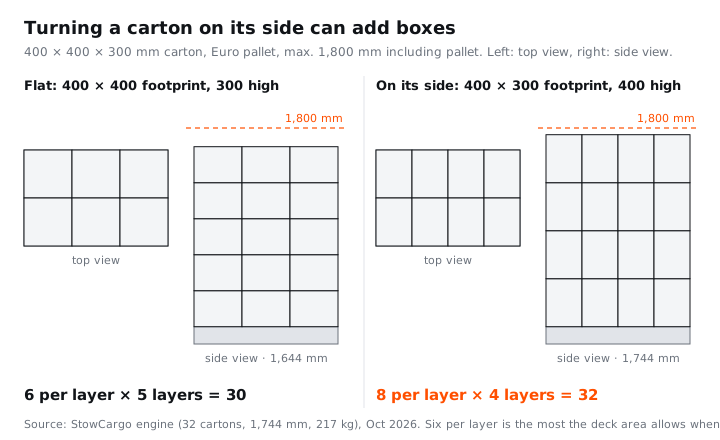
The engine also chose the on-side layout for the 500 × 300 × 250 mm carton: a 300 × 250 footprint, 500 mm high, 12 per layer and 3 layers for 36 cartons. That leaves a 50 mm gap along the pallet's 800 mm side, but uses the height better.
Two conditions apply. The carton must not carry an orientation mark, and its side walls must be able to carry the load above. For liquids, glass or anything orientation-sensitive, keep the carton upright; you'll get a few boxes less but lower damage risk.
Column stacking or interlocking: which pallet pattern?
There are two basic pallet patterns, and the right one depends on carton strength and how rough the journey is.
- Column stacking: every layer is identical, so cartons sit corner on corner and wall on wall. Corrugated cartons typically carry most of their load through the corners and walls, so columns are strong in compression. The weakness is that columns aren't tied together, which makes stretch wrap and edge protectors more important.
- Interlocking: layers are rotated or offset like bricks in a wall. Cartons lock together and the pallet holds its shape better under vibration. The trade-off is that carton corners may rest on the middle of the carton below, which can reduce stacking strength.
Boxes per layer is often the same in both patterns; what changes is stability and crush resistance. Interlocking is common for long, bumpy journeys, columns for heavy, tall stacks. Either way, stretch-wrap the pallet and keep cartons inside the pallet edge.
How do pallets translate into trucks?
Once you know boxes per pallet, the question moves to the vehicle. For 3,000 cartons of 600 × 400 × 400 mm, the StowCargo engine gives:
- 3,000 ÷ 16 = 187.5, so 188 Euro pallets.
- Each loaded pallet is 1,744 mm high. Two stacked would be 3,488 mm, which doesn't fit a curtainsider with 2,700 mm internal height, so pallets go in a single layer.
- A 13.6 m curtainsider takes 34 Euro pallets in one layer: 188 pallets need 6 trailers (five full trailers plus 18 pallets on the sixth).
- Weight isn't the limit: a full trailer carries 34 × 153 kg = 5,202 kg, well under the typical 24,000 kg payload.
What if the same cartons were floor-loaded without pallets? The engine fits at most 884 of these cartons in a 13.6 m curtainsider. Three trailers can take at most 2,652, so 3,000 cartons need at least four trailers. In this case, pallets cost up to two trailers' worth of space; in return, loading, unloading and warehouse handling go by forklift. Putting numbers on that trade-off makes the pallet versus floor-load decision much easier.
For part-load pricing, the pallets come to 188 × 0.4 = 75.2 loading meters. See loading meters (LDM) for the formula, how many pallets fit in a truck for every vehicle, and the 13.6 m curtainsider page for the trailer's dimensions.
What are the most common palletizing mistakes?
- Using inner dimensions. The inner size is what fits the product; the outer size is what fits the pallet.
- Forgetting the pallet height. If 1,800 mm includes the pallet, cartons get 1,656 mm, not 1,800.
- Rounding layers up. 4.14 layers is 4 layers. Pallets, on the other hand, round up: 187.5 pallets is 188.
- Testing one orientation only. As the examples show, skipping the on-side options can cost a few cartons per pallet.
- Skipping the weight check. Light cartons won't hit it, but heavy cartons reach the pallet or forklift limit before the height limit.
- Ignoring overhang. Cartons sticking out past the deck enlarge the footprint and cut the number of pallets per trailer.
How does palletizing work in StowCargo?
To see how many cartons or pallets of a single product fit in a truck, use the free load calculator, no account needed. Building cartons onto pallets happens in the workspace: choose “Palletize” on a packing list row, and the engine first builds cartons onto pallets, then loads the pallets into the vehicle. Pallet type (Euro, industrial, half), maximum pallet height and maximum load per pallet are settings. Each product first fills its own full pallets; leftover cartons that don't make a full pallet are combined into mixed pallets per delivery stop.
Once the plan is ready, you can send step-by-step instructions to the warehouse as a phone link, so loaders see which pallet goes in when. See step-by-step warehouse loading for details.
Conclusion
To find how many boxes fit on a pallet, work out boxes per layer, the number of layers and the weight limit, then turn the carton and lay it on its side to find the best orientation. On a Euro pallet, a 600 × 400 × 400 mm carton gives 16, a 400 × 300 × 300 mm carton 40, and a 300 × 200 × 200 mm carton 128. Three thousand cartons become 188 pallets and six trailers.
If you'd rather let the engine do this for every product on a mixed packing list, see plans and pricing.