Trailer Types and Dimensions: Curtainsider, Mega, Reefer
Internal dimensions, payloads, pallet and carton capacity for curtainsider, mega, reefer, flatbed and box trailers and rigid trucks, which cargo suits which, and the legal size limits in the EU and Turkey.
· 12 min read
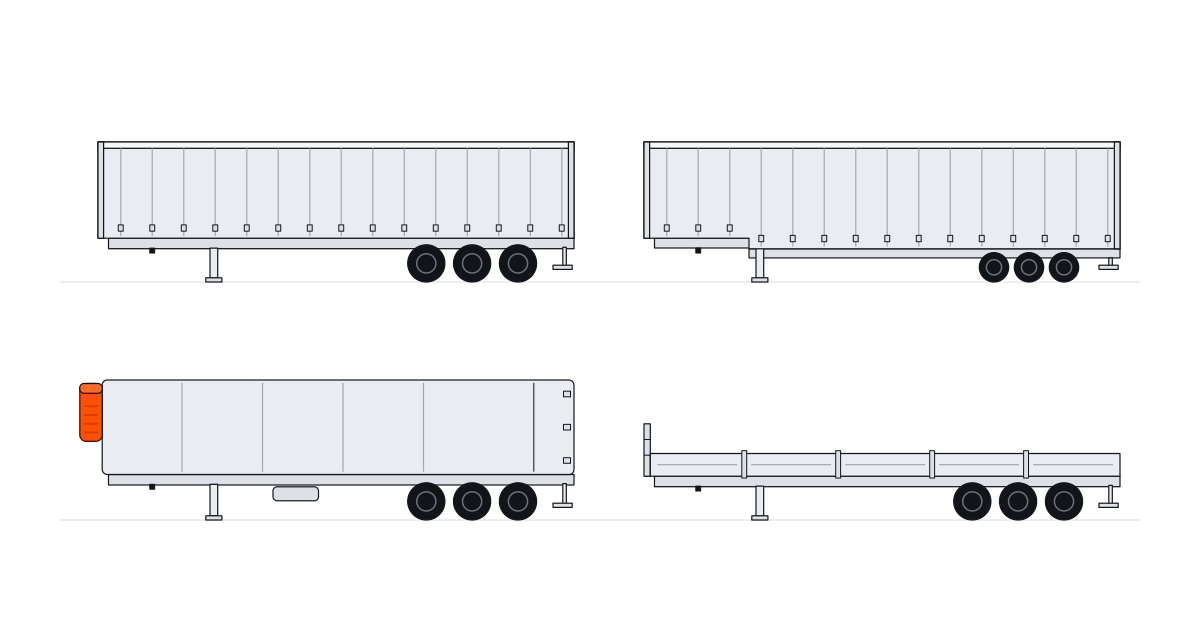
The most common semi-trailer types in European and Turkish road freight are the curtainsider, the mega trailer, the reefer (refrigerated trailer), the flatbed and the box trailer. Most share nearly the same floor: a 13.60 m curtainsider, mega or flatbed takes 34 Euro pallets in a single layer. What really sets them apart is internal height, payload, temperature control and how the cargo gets in: from the rear, the side or the top.
This guide gives typical internal dimensions, payload, pallet and carton capacity for each type, explains which cargo suits which trailer, and summarizes the legal size limits in the EU and Turkey. Pallet and carton counts come from the StowCargo packing engine; internal dimensions are typical values and vary by a few centimetres between manufacturers.
What is a semi-trailer, and how is it different from a rigid truck?
A semi-trailer is a cargo unit without its own engine whose front end rests on a tractor unit via the kingpin and fifth wheel. Together, the tractor and semi-trailer form an articulated vehicle, often just called a truck or, in Europe, a "trailer". On a rigid truck, by contrast, the cargo body is fixed to the vehicle's own chassis.
That difference matters for loading. A semi-trailer can be dropped at the warehouse and loaded while the tractor does other work. Its load weight is shared between the trailer axles and, through the kingpin, the tractor, so where the cargo sits directly changes the axle loads. Rigid trucks have shorter floors but are more practical for regional and city distribution.
Semi-trailer dimensions: comparison table
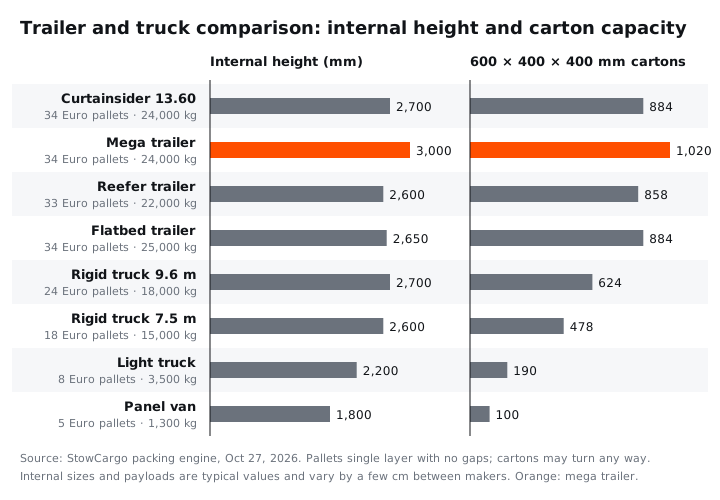
The table below shows typical internal dimensions and payloads for common trailers and trucks, with the pallet and carton counts calculated by the StowCargo packing engine. Pallets are in one layer with no gaps; in practice you may plan one row less for forklift clearance and securing. Cartons are 600 × 400 × 400 mm and may be turned any way.
| Vehicle | Internal L × W × H (mm) | Payload | Euro pallets | Industrial pallets | Cartons | Volume utilization |
|---|---|---|---|---|---|---|
| Curtainsider 13.60 | 13,600 × 2,480 × 2,700 | 24,000 kg | 34 | 26 | 884 | 93.2% |
| Mega trailer | 13,600 × 2,480 × 3,000 | 24,000 kg | 34 | 26 | 1,020 | 96.8% |
| Reefer trailer | 13,300 × 2,460 × 2,600 | 22,000 kg | 33 | 26 | 858 | 96.8% |
| Flatbed trailer | 13,600 × 2,480 × 2,650 | 25,000 kg | 34 | 26 | 884 | 94.9% |
| Rigid truck 9.6 m | 9,600 × 2,450 × 2,700 | 18,000 kg | 24 | 18 | 624 | 94.3% |
| Rigid truck 7.5 m | 7,500 × 2,450 × 2,600 | 15,000 kg | 18 | 14 | 478 | 96.1% |
| Light truck | 4,300 × 2,100 × 2,200 | 3,500 kg | 8 | 6 | 190 | 91.8% |
| Panel van (long) | 3,500 × 1,750 × 1,800 | 1,300 kg | 5 | 3 | 100 | 87.1% |
Volume utilization is the total volume of the cartons that fit, divided by the vehicle's internal volume. The jump from 93.2% in a curtainsider to 96.8% in a mega trailer happens because 400 mm cartons stack into 3,000 mm with less wasted headroom. Full specs and engine drawings for every vehicle are in the truck and container dimensions guide.
Curtainsider: the standard full-truckload trailer
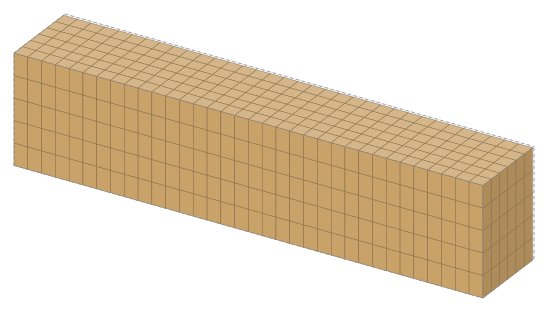
A curtainsider is a semi-trailer with tarpaulin side curtains, often a tarpaulin roof, and rear doors. Its typical internal size is 13,600 × 2,480 × 2,700 mm with a 24,000 kg payload. In one layer it takes 34 Euro pallets, 26 industrial pallets or 884 cartons of 600 × 400 × 400 mm.
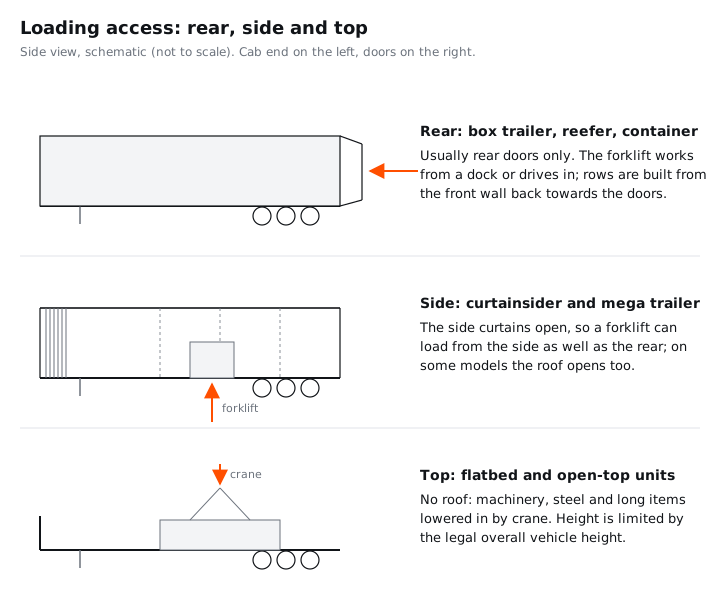
Access is its main strength: open the side curtains and a forklift can load from the side without a loading dock. That makes it the default vehicle for general cargo, palletized industrial goods and mixed shipments. It is also the reference vehicle for part loads, which is why loading metres are measured against its 13.60 m floor; see FTL vs LTL for how to choose between a full truck and a part load. Full measurements are on the 13.60 m curtainsider page.
Curtainsider vs box trailer
The difference between a curtainsider and a box trailer comes down to access versus protection. A box trailer has rigid walls and a rigid roof and is usually loaded only through the rear doors, often from a dock. It protects cargo better against weather and unauthorized access, so it's popular for electronics, high-value goods and cartons handled by hand. A curtainsider trades some of that protection for side loading and faster turnaround at sites without docks.
Curtains are not a load restraint. In a curtainsider, what stops cargo from sliding or tipping is the securing: lashing straps, anti-slip mats and blocking where needed. For friction lashing and how side curtains are treated, see load securing under EN 12195-1.
Box trailer internal sizes vary a lot by manufacturer and body construction, so we don't publish a typical figure. When you plan with one, use the internal dimensions and payload from the vehicle's documents; StowCargo lets you set it up as a custom vehicle.
Mega trailer: for light, bulky cargo
A mega trailer offers more internal volume on the same floor as a curtainsider. Typical internal dimensions are 13,600 × 2,480 × 3,000 mm, which is 300 mm (about 11%) taller than a standard curtainsider, with the same 24,000 kg payload. The extra height usually comes from a lower deck and smaller wheels, and the tractor needs a matching low fifth-wheel height.
From the same 600 × 400 × 400 mm carton, 884 fit in a curtainsider and 1,020 in a mega trailer: 136 more, or about 15%. The pallet count doesn't change (34 Euro pallets in one layer) because the floor is the same; the gain is all in height. That's why mega trailers are popular for textiles, furniture, white goods, packaging and foam. For tall pallets stacked two high, the extra 300 mm is often what makes stacking possible at all.
For heavy cargo a mega trailer gains nothing: its payload matches the curtainsider's, and dense freight reaches the weight limit long before it reaches the roof. Details are on the mega trailer page.
Reefer trailer: for temperature-controlled cargo
A reefer is a closed semi-trailer with insulated walls and a refrigeration unit, used for food, pharmaceuticals, flowers, chemicals and anything else that must travel at a set temperature. Insulation and the unit reduce the internal space: a typical reefer is 13,300 × 2,460 × 2,600 mm inside. Its payload is also lower, typically 22,000 kg.
In one layer it takes 33 Euro pallets, 26 industrial pallets or 858 cartons, one pallet and 26 cartons fewer than a curtainsider. The law recognizes this construction too: in both the EU and Turkey the general width limit is 2.55 m, but refrigerated bodies may be up to 2.60 m wide.
Reefers are usually loaded from the rear only, with pallets built from the front wall back towards the doors. Plan the load pattern following the unit's and the carrier's instructions so cold air can circulate around the cargo, and never block the unit's air outlet. Details are on the reefer trailer page.
Flatbed trailer: for crane-loaded cargo
A flatbed is an open platform with no roof and no side walls. It carries machinery, steel sections, coils, pipes, building materials and long items that are lifted in by crane or loaded from the side by forklift. Its floor matches the curtainsider's (13,600 × 2,480 mm), so it takes 34 Euro pallets in one layer, and its typical payload is 25,000 kg.
A flatbed has no internal height. The upper limit is set by the legal overall vehicle height of 4.00 m. StowCargo plans flatbeds with a 2,650 mm load height, assuming the deck sits about 1.35 m above the road. Deck heights vary between trailers, so for tall cargo use your own vehicle's measurement. Because the load is exposed, sheeting and securing are part of the job. Specs are on the flatbed trailer page.
Rigid trucks and vans
Not every shipment needs an articulated truck. Rigid trucks and vans, with their shorter floors, handle regional and city distribution, small consignments and the remainder of multi-truck orders.
- Rigid truck 9.6 m (4 axles): 9,600 × 2,450 × 2,700 mm, 18,000 kg, 24 Euro pallets. Shorter than a semi-trailer but carries heavy loads. See the 9.6 m rigid truck page.
- Rigid truck 7.5 m (3 axles): 7,500 × 2,450 × 2,600 mm, 15,000 kg, 18 Euro pallets. For mid-size part loads and city deliveries. See the 7.5 m rigid truck page.
- Light truck: 4,300 × 2,100 × 2,200 mm, 3,500 kg, 8 Euro pallets, for small consignments and fast deliveries.
- Panel van (long): 3,500 × 1,750 × 1,800 mm, 1,300 kg, 5 Euro pallets, for samples and courier loads.
On light trucks and vans narrower than 2.40 m inside, the floor width decides how many pallets fit; loading metres only matter there as a pricing unit.
Which trailer suits which cargo?
Three questions pick the trailer: is the cargo heavy or bulky, does it need temperature control, and where will it be loaded from?
| Cargo | Suitable vehicle | Why |
|---|---|---|
| Palletized general cargo, mixed shipments | Curtainsider | Standard floor, side and rear loading |
| Light, bulky goods (textiles, furniture, white goods) | Mega trailer | 300 mm more height on the same floor |
| Food, pharmaceuticals, flowers | Reefer trailer | Insulation and refrigeration unit |
| Machinery, steel, long or crane-lifted items | Flatbed | No roof, top and side access |
| High-value or weather-sensitive cartons | Box trailer | Rigid walls and roof, lockable rear doors |
| Regional distribution, small consignments | Rigid truck, light truck | Shorter floor, more agile |
For heavy cargo, payload and axle distribution usually decide, not the floor. For example, 24 pallets at 1,000 kg each reach a curtainsider's 24,000 kg payload while using only 71% of the floor. For bulky cargo, height decides, and that's where the mega trailer earns its place.
What are the maximum truck dimensions in the EU and Turkey?
In the EU, Council Directive 96/53/EC (EUR-Lex) sets the maximum dimensions and weights that member states must accept for international traffic:
- Length: 16.50 m for an articulated vehicle (tractor plus semi-trailer); 12.00 m for a rigid motor vehicle; 18.75 m for a road train.
- Width: 2.55 m in general; 2.60 m for the bodies of refrigerated (conditioned) vehicles.
- Height: 4.00 m.
- Weight: 40 tonnes for a two-axle tractor with a three-axle semi-trailer.
Turkey applies the same core limits. The loading regulation published by the Turkish Ministry of Transport and Infrastructure lists 2.55 m width (2.60 m for refrigerated bodies), 4.00 m height, 16.50 m for articulated vehicles and 40 tonnes for articulated vehicles with five or more axles. It also prohibits exceeding the registered gross weight or the axle limits.
These limits apply to the vehicle's outer dimensions; a trailer's internal size is smaller by the thickness of its walls, roof and floor. Regulations change from time to time, so check the current text before planning an unusual shipment.
How do you choose the right trailer with a load plan?
The most reliable method is to try the same packing list in several vehicles. A load that needs two curtainsiders might fit one mega trailer; a heavy load gains nothing from the extra height. Working that out by hand is hard for mixed cargo.
In StowCargo you enter your packing list once and switch vehicles to compare: the number of vehicles, load length, volume utilization, weight and estimated axle loads are recalculated for each. For a single product in a single vehicle, the free load calculator works without an account.
Conclusion
Trailer types differ less in floor size than in height, payload, temperature control and access. A curtainsider is the right starting point for palletized general cargo, a mega trailer for light and bulky goods, a reefer for the cold chain, and a flatbed for heavy or long items loaded by crane. To settle the choice, plan your load in a few vehicles and compare the number of trucks and the load length.
To see internal sizes, pallet and carton capacity and engine drawings for every vehicle, browse the truck and container dimensions guide.