Euro Pallet Dimensions, Weight and Load Capacity
A Euro pallet measures 1,200 × 800 mm, stands 144 mm high, weighs about 25 kg and has a safe working load of 1,500 kg. Industrial and half pallet sizes, LDM values and how many pallets fit in each truck and container.
· 11 min read
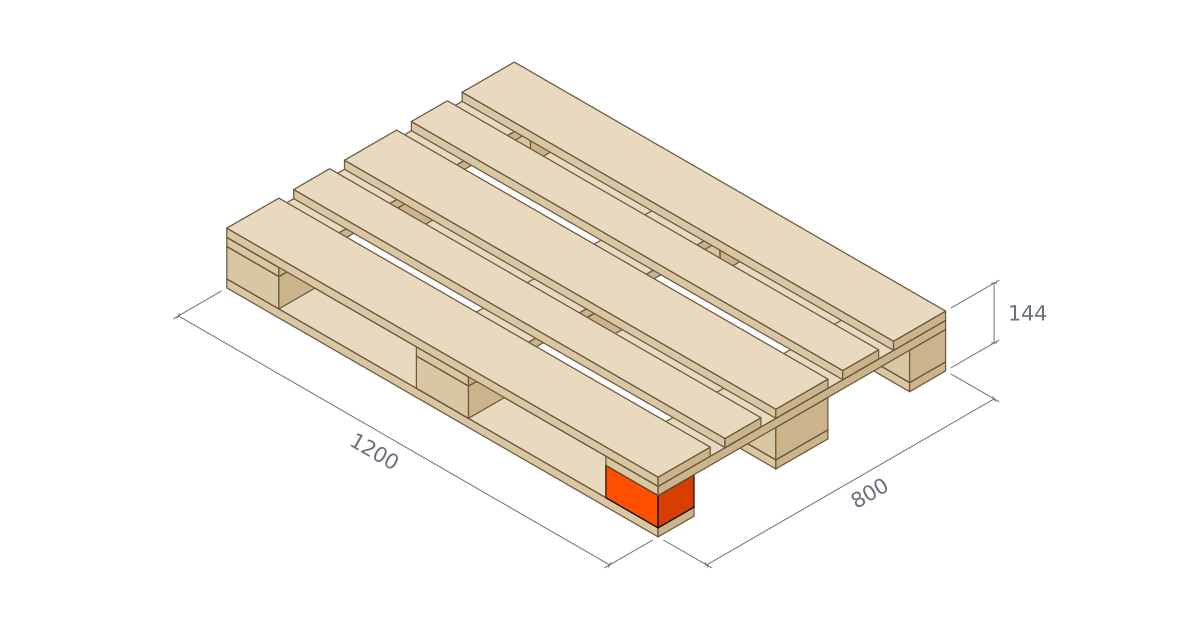
The Euro pallet is the default load carrier for European road freight, and the starting point for every trailer plan, freight quote, packing list and racking calculation that involves Europe. Get its size wrong and you plan one row of pallets too many, or too few.
The short answer: a Euro pallet measures 1,200 × 800 mm, stands 144 mm high, weighs about 25 kg empty and has a safe working load of 1,500 kg. Those figures come from the Euro pallet technical data published by the European Pallet Association (EPAL), which licenses the pallet (2026). Below you'll also find industrial and half pallet sizes, how many loading meters each pallet takes, and how many fit in each truck and container.
What are the dimensions of a Euro pallet?
A Euro pallet is 1,200 mm long, 800 mm wide and 144 mm high. The footprint is defined by the European standard EN 13698-1:2003, which describes it as a double-deck, non-reversible, four-way entry wooden pallet with nine blocks. Pallets branded “EPAL” or “EUR” are built under EPAL's licence and quality control.
EPAL's published technical data:
| Property | Euro pallet (EPAL 1) |
|---|---|
| Footprint | 1,200 × 800 mm |
| Height | 144 mm |
| Empty weight | approx. 25 kg |
| Safe working load | 1,500 kg |
| Load on the bottom pallet in a stack | max. 5,500 kg (solid, level surface) |
| Construction | 11 boards, 9 blocks, 78 nails |
| Fork entry | four-way |
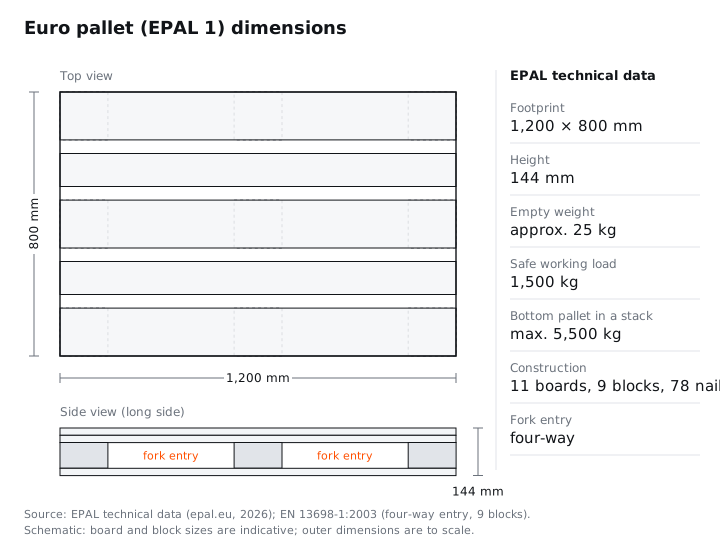
One detail trips people up: EPAL's own page lists 800 mm as the “length” and 1,200 mm as the “width”. Freight forwarders, carriers and planning tools almost always write the long side first, as “1,200 × 800”. Same pallet, different order.
In US terms, the Euro pallet is roughly 47.2 × 31.5 inches and 5.7 inches high, and weighs about 55 lb. It is noticeably narrower than the 48 × 40 inch pallet common in North America.
How much does a Euro pallet weigh?
An empty Euro pallet weighs about 25 kg. Wood moisture and species shift the figure by a few kilograms, which is why EPAL says “approx.”. Add pallet weight when you calculate gross weight for the packing list and the vehicle: on a trailer with 34 Euro pallets, the empty pallets alone come to roughly 850 kg.
How much weight can a Euro pallet hold?
According to EPAL, a Euro pallet has a safe working load of 1,500 kg. When loaded pallets are stacked on a solid, level surface, the bottom pallet may carry up to 5,500 kg. These ratings apply to the pallet itself; racking, conveyors and uneven load distribution are different conditions, so check your racking or pallet supplier for those.
In practice, the pallet is rarely the binding limit. Carton crush strength, racking capacity and vehicle payload usually kick in first. Thirty-four pallets at 1,500 kg each would be 51 tonnes, while a 13.6 m curtainsider has a typical payload of 24,000 kg. With heavy goods, a trailer runs out of weight long before it runs out of floor.
What are industrial pallet dimensions and other standard sizes?
The industrial pallet, also listed as the ISO 2 pallet, has a 1,200 × 1,000 mm footprint. Its wooden construction is covered by EN 13698-2:2009. EPAL licenses two pallets with this footprint, the EPAL 2 and the EPAL 3: same footprint, different construction, height and rating. The half pallet (EPAL 6) is half a Euro pallet.
| Pallet | Footprint | Height | Weight (approx.) | Safe working load | LDM |
|---|---|---|---|---|---|
| Euro pallet (EPAL 1) | 1,200 × 800 mm | 144 mm | 25 kg | 1,500 kg | 0.4 |
| Industrial (EPAL 2) | 1,200 × 1,000 mm | 162 mm | 35 kg | 1,250 kg | 0.5 |
| Industrial (EPAL 3) | 1,000 × 1,200 mm | 144 mm | 30 kg | 1,500 kg | 0.5 |
| Half pallet (EPAL 6) | 800 × 600 mm | 144 mm | 9.5 kg | 750 kg | 0.2 |
Source: EPAL technical data, 2026; half pallet figures from the EPAL 6 page.
For intercontinental handling, pallet footprints are collected in ISO 6780. GS1's platform type code list maps them as follows: 1,200 × 800 mm (ISO 1, the Euro pallet), 1,200 × 1,000 mm (ISO 2), 1,219 × 1,016 mm (ISO 3, the 48 × 40 inch pallet used mainly in the Americas), 1,067 × 1,067 mm (ISO 4), 1,100 × 1,100 mm (common in Asia-Pacific) and 1,140 × 1,140 mm (ISO 6).
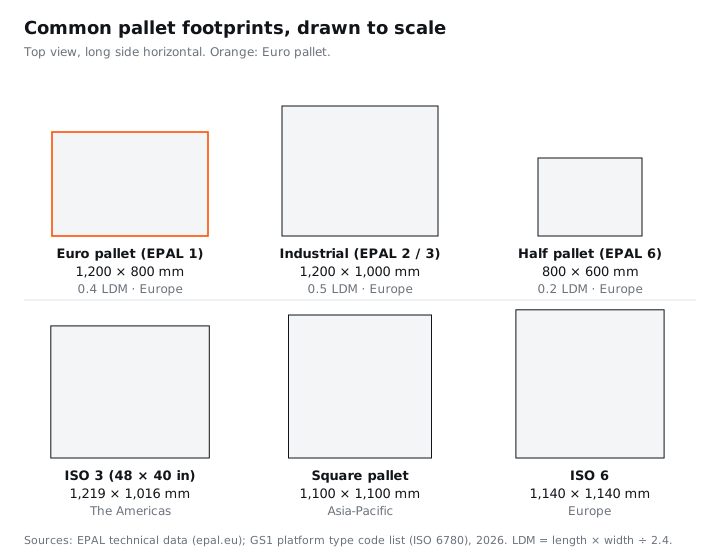
Which pallet you use depends on the consignee's warehouse and the transport mode. For road freight inside Europe, the Euro pallet uses trailer width best. The industrial pallet is the choice when packaging is too wide for a Euro pallet deck. For containers bound for North America, the buyer may ask for 48 × 40 inch pallets, so confirm it at order stage.
How many loading meters is a Euro pallet?
A Euro pallet takes 0.4 loading meters (LDM). The formula is LDM = length × width ÷ 2.4, so 1.2 × 0.8 ÷ 2.4 = 0.4. The same math gives 0.5 LDM for an industrial pallet and 0.2 LDM for a half pallet. A 13.6 m trailer is 13.6 LDM and its floor is exactly filled by 34 Euro pallets.
European carriers often price part loads by LDM. Ten non-stackable Euro pallets take 4 LDM; the same ten pallets stacked two high take 2 LDM. For worked examples, overhang and common quoting mistakes, see our guide to loading meters (LDM).
How many Euro pallets fit in a truck or container?
A 13.6 m curtainsider takes 34 Euro pallets or 26 industrial pallets in a single layer. Dry containers take fewer: 11 Euro pallets in a 20ft, 25 in a 40ft. The counts below come from the StowCargo packing engine (October 2026), with pallets in one layer on the floor and no gaps between them. Internal dimensions are typical and vary by a few centimeters between manufacturers.
| Vehicle | Internal L × W × H (mm) | Max payload | Euro pallets | Industrial pallets |
|---|---|---|---|---|
| Curtainsider trailer 13.6 m | 13,600 × 2,480 × 2,700 | 24,000 kg | 34 | 26 |
| Mega trailer | 13,600 × 2,480 × 3,000 | 24,000 kg | 34 | 26 |
| Reefer trailer | 13,300 × 2,460 × 2,600 | 22,000 kg | 33 | 26 |
| Flatbed trailer | 13,600 × 2,480 × 2,650 | 25,000 kg | 34 | 26 |
| Rigid truck 9.6 m | 9,600 × 2,450 × 2,700 | 18,000 kg | 24 | 18 |
| Rigid truck 7.5 m | 7,500 × 2,450 × 2,600 | 15,000 kg | 18 | 14 |
| Light truck | 4,300 × 2,100 × 2,200 | 3,500 kg | 8 | 6 |
| Panel van (long) | 3,500 × 1,750 × 1,800 | 1,300 kg | 5 | 3 |
| 20ft Dry | 5,898 × 2,352 × 2,393 | 28,200 kg | 11 | 10 |
| 40ft Dry | 12,032 × 2,352 × 2,393 | 26,700 kg | 25 | 22 |
| 40ft High Cube | 12,032 × 2,352 × 2,698 | 26,500 kg | 25 | 22 |
| 45ft High Cube | 13,556 × 2,352 × 2,698 | 27,700 kg | 27 | 24 |
| 20ft Reefer | 5,444 × 2,294 × 2,276 | 27,400 kg | 10 | 9 |
| 40ft Reefer High Cube | 11,583 × 2,294 × 2,554 | 29,000 kg | 23 | 20 |
On a trailer, 34 comes from loading pallets two abreast with the 1,200 mm side across the deck: 17 rows × 800 mm = 13,600 mm. That leaves zero slack, so many planners book 33 or 32. The patterns are explained in how many pallets fit in a truck, and the trailer drawing is on the 13.6 m curtainsider page.
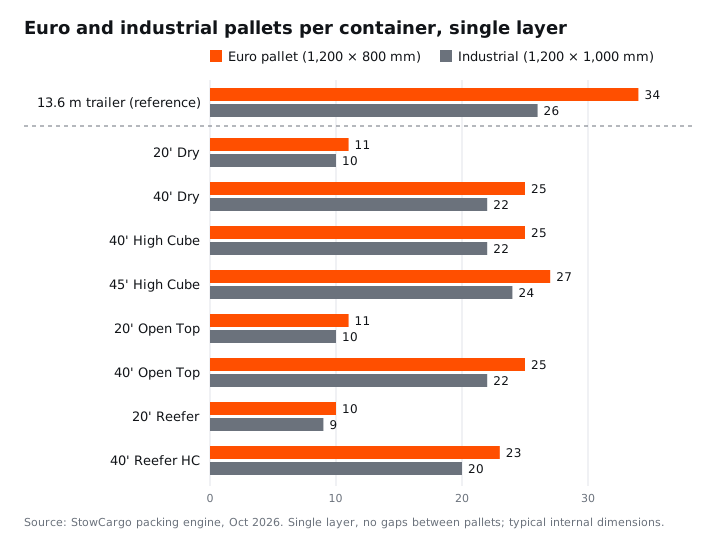
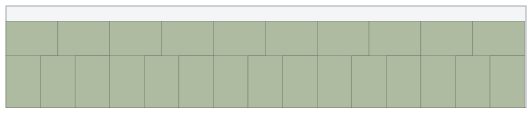
Euro pallets fit worse in containers because of width. A dry container is 2,352 mm wide inside, while three Euro pallets side by side on their 800 mm sides need 2,400 mm. The best container layout therefore mixes lanes: pallets crosswise in one lane and lengthwise in the other.
For external and internal container sizes, see shipping container dimensions.
How high can a pallet load be?
There is no single standard height limit for a loaded pallet. The limit comes from the vehicle's internal height, the door opening, warehouse racking and whether the load stays stable. A quick check for double stacking: two loaded pallets together must be lower than the vehicle's internal height.
- Curtainsider (2,700 mm internal): for two tiers, each pallet must stay under 1,350 mm including clearance.
- Mega trailer (3,000 mm): the same math allows roughly 1,500 mm per pallet.
- 40ft High Cube (2,698 mm): similar to a curtainsider; a standard 40ft (2,393 mm) is lower.
That is geometry only. Whether the bottom pallet and its cartons can carry the top pallet is a separate question. In StowCargo's palletizing settings, maximum pallet height (including the pallet) can be set to 1.2, 1.5, 1.8 or 2.2 m; the default is 1.8 m.
What should you check when shipping on Euro pallets?
The pallet's size is fixed; the space your load takes is not. Check these points before you plan:
- Measure overhang. Cartons sticking out past the deck enlarge the footprint. A Euro pallet with 10 mm overhang on every side becomes 1,220 × 820 mm, so only 13,600 ÷ 820 = 16 rows fit crosswise in a 13.6 m trailer: 32 pallets instead of 34.
- Include pallet weight in gross weight. At about 25 kg per pallet, the difference adds up on the packing list and in axle load estimates.
- Think about fork direction. Euro pallets are four-way entry, so a forklift can pick them from either the long or the short side, which makes crosswise loading on a trailer easier.
- Check the heat treatment mark for export. According to EPAL, newly produced EPAL pallets have been heat-treated to ISPM 15 since 2010 and carry the mark. Countries that enforce wood packaging rules look for it.
- Don't mix footprints in one stack. If Euro and industrial pallets share a trailer, plan their rows separately; stacking pallets with different footprints leaves the edges of the upper pallet unsupported.
How can you calculate your own pallet load?
For a single pallet type, try the free load calculator, no account needed: choose Euro or industrial, enter the loaded height and weight, and pick a vehicle. The engine runs in your browser and shows how many pallets fit, or how many vehicles you need, in a few seconds. Internal sizes and drawings for every vehicle are in the truck and container size guide.
If your goods aren't palletized yet, work out how many cartons each pallet takes first. Our guide on how many boxes fit on a pallet walks through cartons per layer, layer count and weight limit with worked examples.
Conclusion
A Euro pallet is 1,200 × 800 × 144 mm, weighs about 25 kg and has a 1,500 kg safe working load. The industrial pallet is 1,200 × 1,000 mm and takes 0.5 LDM. A 13.6 m trailer holds 34 Euro or 26 industrial pallets in one layer, a 40ft container 25 or 22. Overhang, pallet weight and stacking height are the three details that most often change those numbers.
If you ship mixed pallet sizes, palletize cartons or need an axle load check, compare plans and pricing and try the full workspace.